
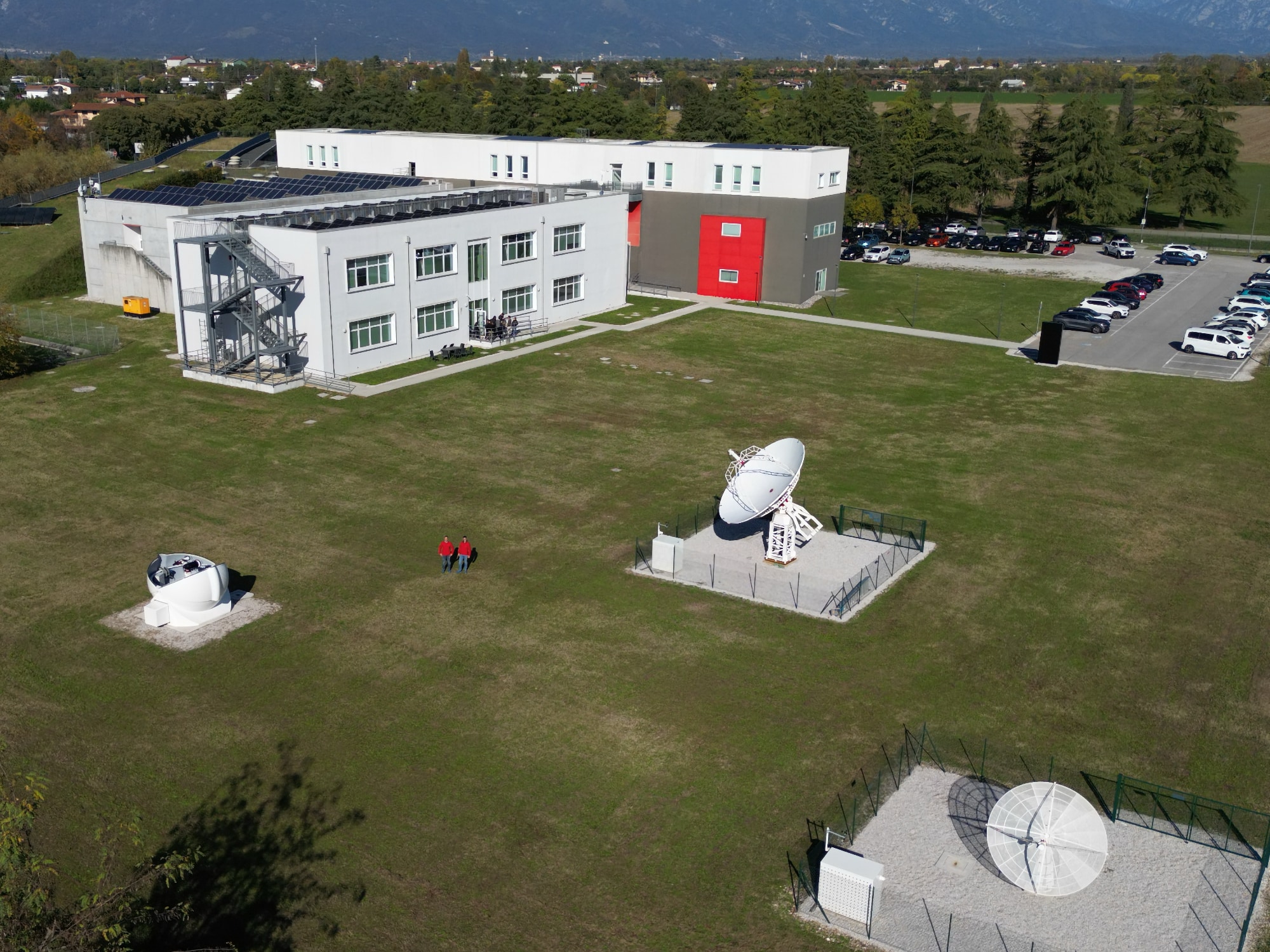
From PL Space Center in Pordenone, our INTREPID 500-20 ground station followed Artemis II, NASA’s first crewed lunar mission in 50 years, verifying its position in cislunar space session by session.
What is Artemis II, and why does it matter
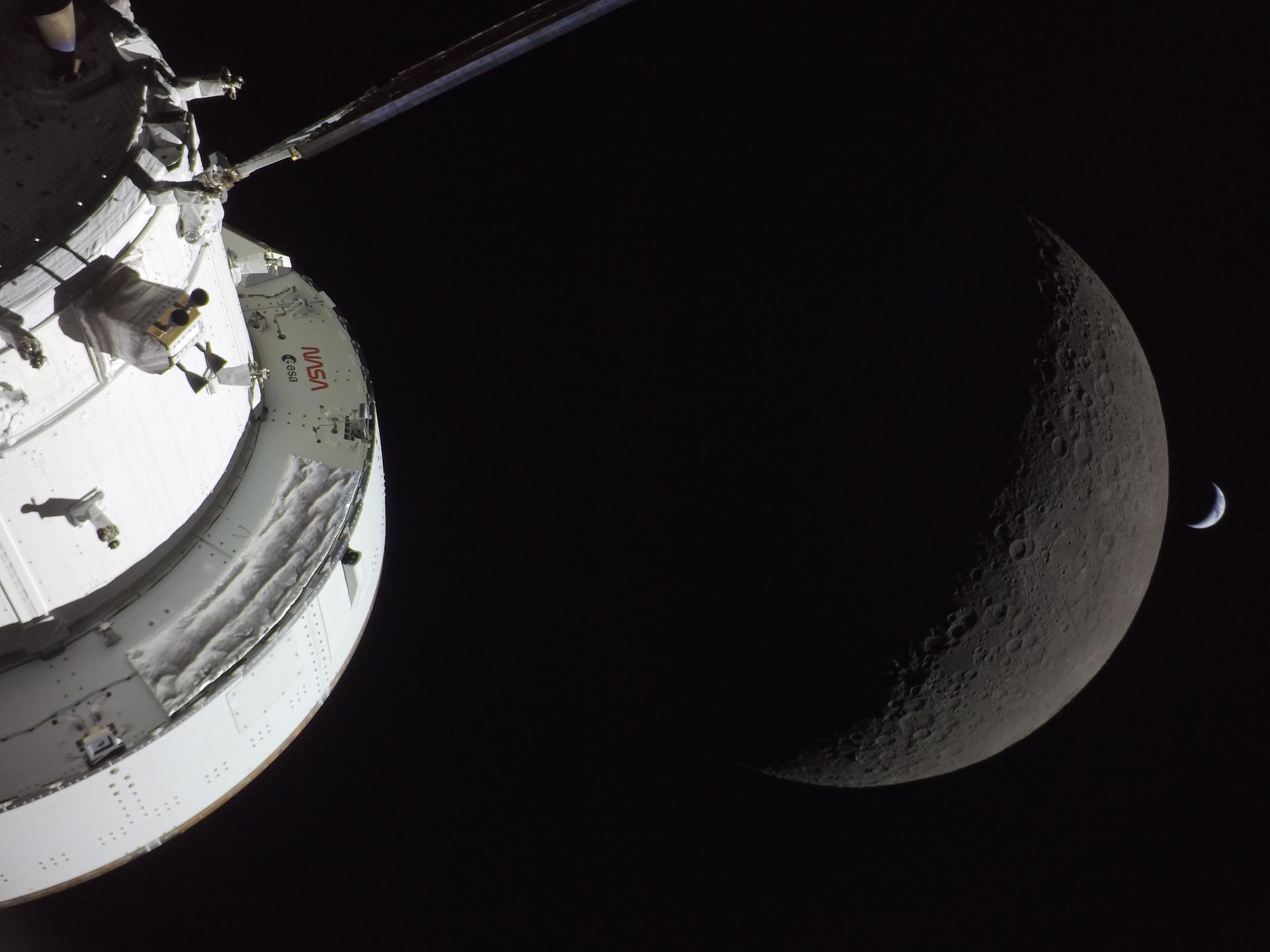
Artemis II is NASA‘s first crewed mission beyond low Earth orbit since Apollo 17 in 1972. Four astronauts, Reid Wiseman, Victor Glover, Christina Koch, and Jeremy Hansen, flew aboard the Orion spacecraft on a free-return trajectory around the Moon, reaching cislunar space before returning safely to Earth. The mission is not a lunar landing. It is something even more fundamental: a demonstration that humans can travel safely through the deep radiation environment of cislunar space, that the life support and navigation systems of Orion work as designed, and that the architecture for Artemis III, the mission that will put humans back on the Moon, is sound. From an engineering standpoint, Artemis II is one of the most demanding missions of the current decade. The spacecraft travels hundreds of thousands of kilometers from Earth, through a region where radio signals weaken, orbital dynamics are governed by the combined gravity of Earth and Moon, and the geometry changes continuously over days. For us at PrimaLuceLab Space Division, it was a challenge we could not pass up.
The key idea: every Doppler measurement is a timestamp on the Artemis II trajectory
Before describing what we did, it is worth explaining why it matters. A spacecraft in cislunar space transmits a continuous radio signal. As it moves, the frequency of that signal shifts slightly, due to the Doppler effect: the same phenomenon that makes an ambulance siren sound higher as it approaches and lower as it moves away. This shift is extremely sensitive to the spacecraft’s velocity along the line of sight to the observer. Here is the key point. At any given moment in a mission, the spacecraft is at a precise point on its trajectory, moving at a precise velocity. Physics dictates exactly what Doppler shift an observer on the ground should measure at that moment. The JPL Horizons system, NASA’s reference for orbital mechanics, can predict this value with high accuracy for any point in time. So if you measure the Doppler shift at a given moment and it matches the predicted value, you are not just receiving a signal. You are confirming that the spacecraft is exactly where it should be, moving exactly as it should be moving, at that precise phase of the mission. This is what we set out to do.
Eight sessions, eight checkpoints along the trajectory
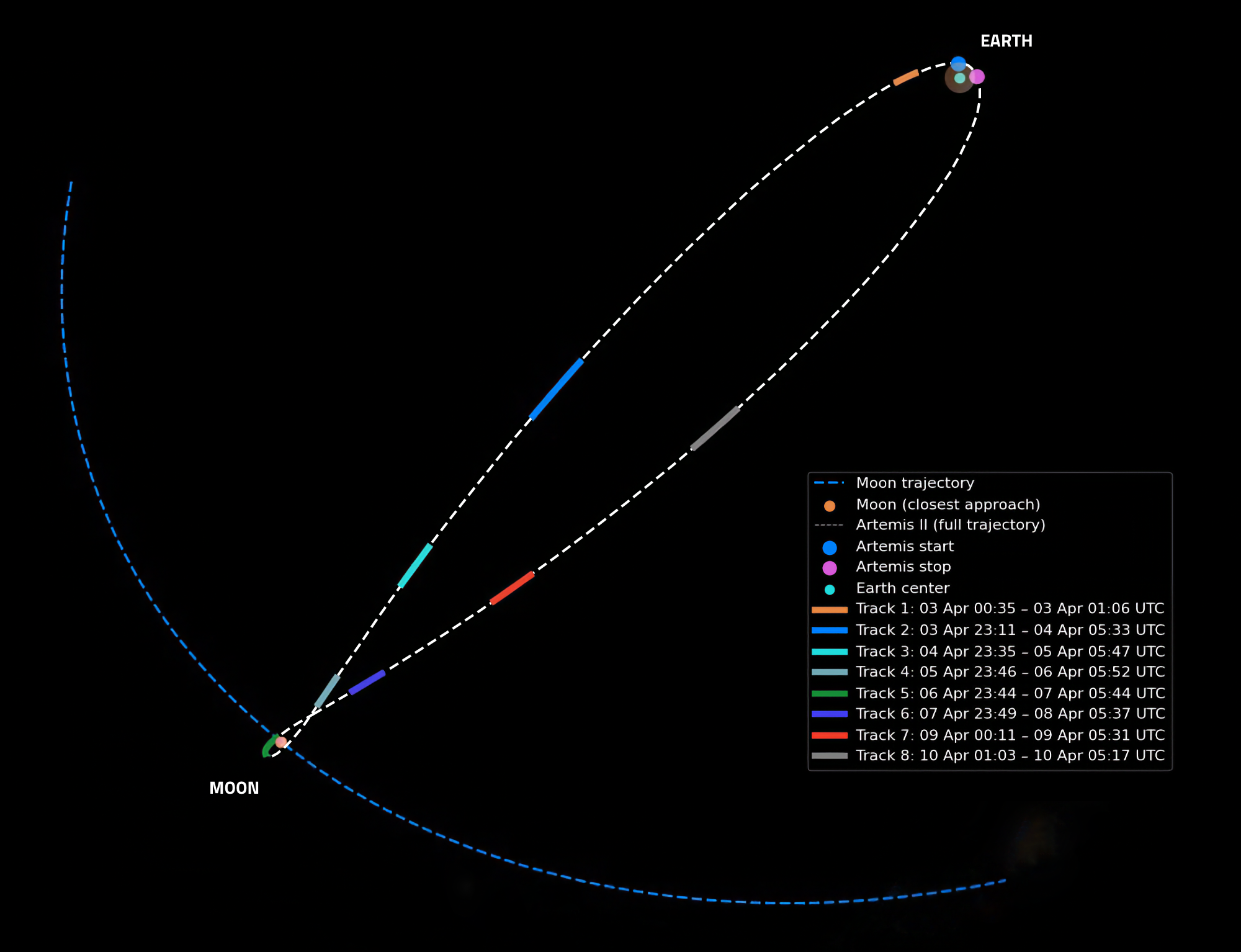
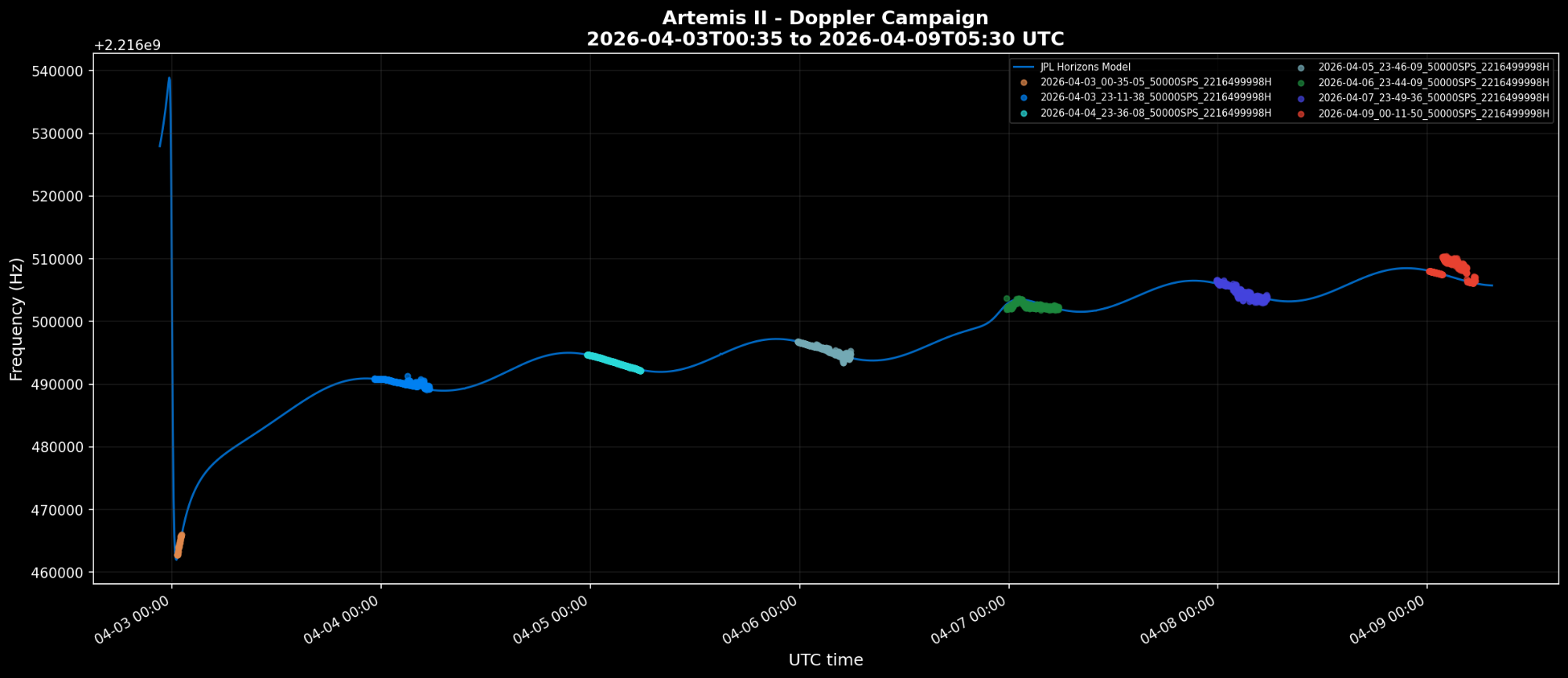
Between April 3 and 9, 2026, our INTREPID 500-20 ground station, installed at the PL Space Center at the Polo Tecnologico Alto Adriatico in Pordenone, conducted eight observation sessions tracking the Orion spacecraft along its cislunar arc. Each session covered a distinct segment of the trajectory, from the translunar injection phase in the first hours after departure, through the outbound arc, past the closest lunar approach, and into the return leg. The colored arcs in the figure show exactly which portion of the trajectory each session covered, and the corresponding Doppler curves below confirm what we measured during that window.
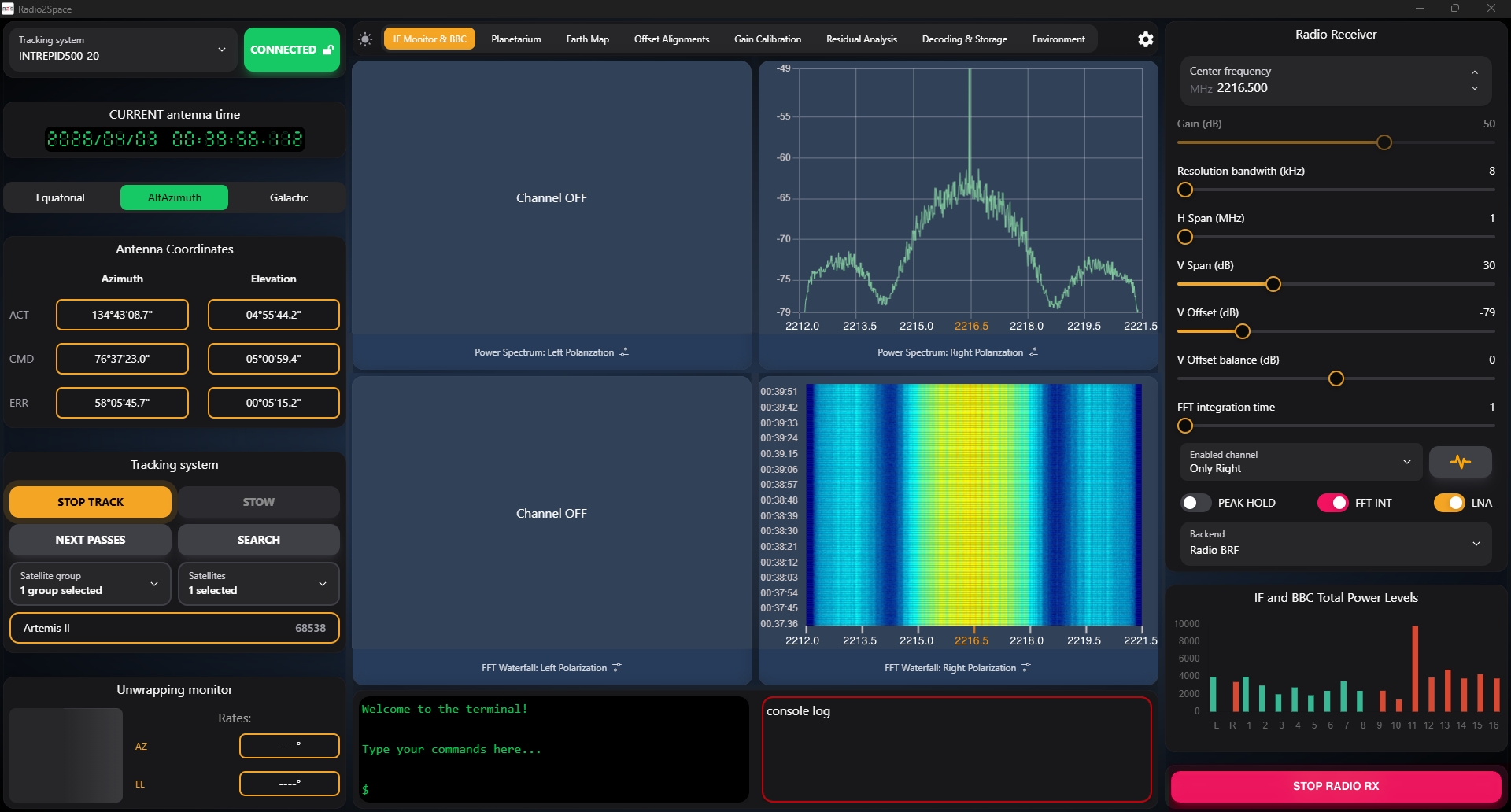
During each session, INTREPID 500-20 locked onto the S-band radio carrier transmitted by Orion and measured its Doppler shift continuously. Each measurement was then compared against the theoretical prediction from JPL Horizons for that exact moment. The agreement was excellent across all eight sessions. The measured Doppler traces matched the predicted model closely throughout the entire campaign. The residuals, the difference between what we measured and what the model predicted, remained within a few hertz over observation arcs of several hours, with a dispersion of roughly 3–4 Hz RMS and no significant drift. This corresponds to an extremely small line-of-sight velocity error. In practical terms: at every checkpoint along the trajectory, our ground station confirmed that Artemis II was where it was supposed to be.
What this requires from a ground station
Achieving this result is not simply a matter of pointing a large antenna at the sky. Several things have to work together precisely.
The first is sensitivity. Orion’s signal, by the time it reaches the ground from cislunar distances, is extraordinarily weak. The antenna and receiver chain must be able to extract a coherent, stable carrier from that signal and hold it across hours of continuous observation.
The second is frequency stability. The Doppler measurement is only as good as the stability of the receiver’s own frequency reference. Any drift in the local oscillator contaminates the measurement. The constant offset of approximately −1894 Hz visible in our residuals is a known, stable bias in the reference chain, not a drift. Its consistency across the campaign confirms the system was behaving coherently.
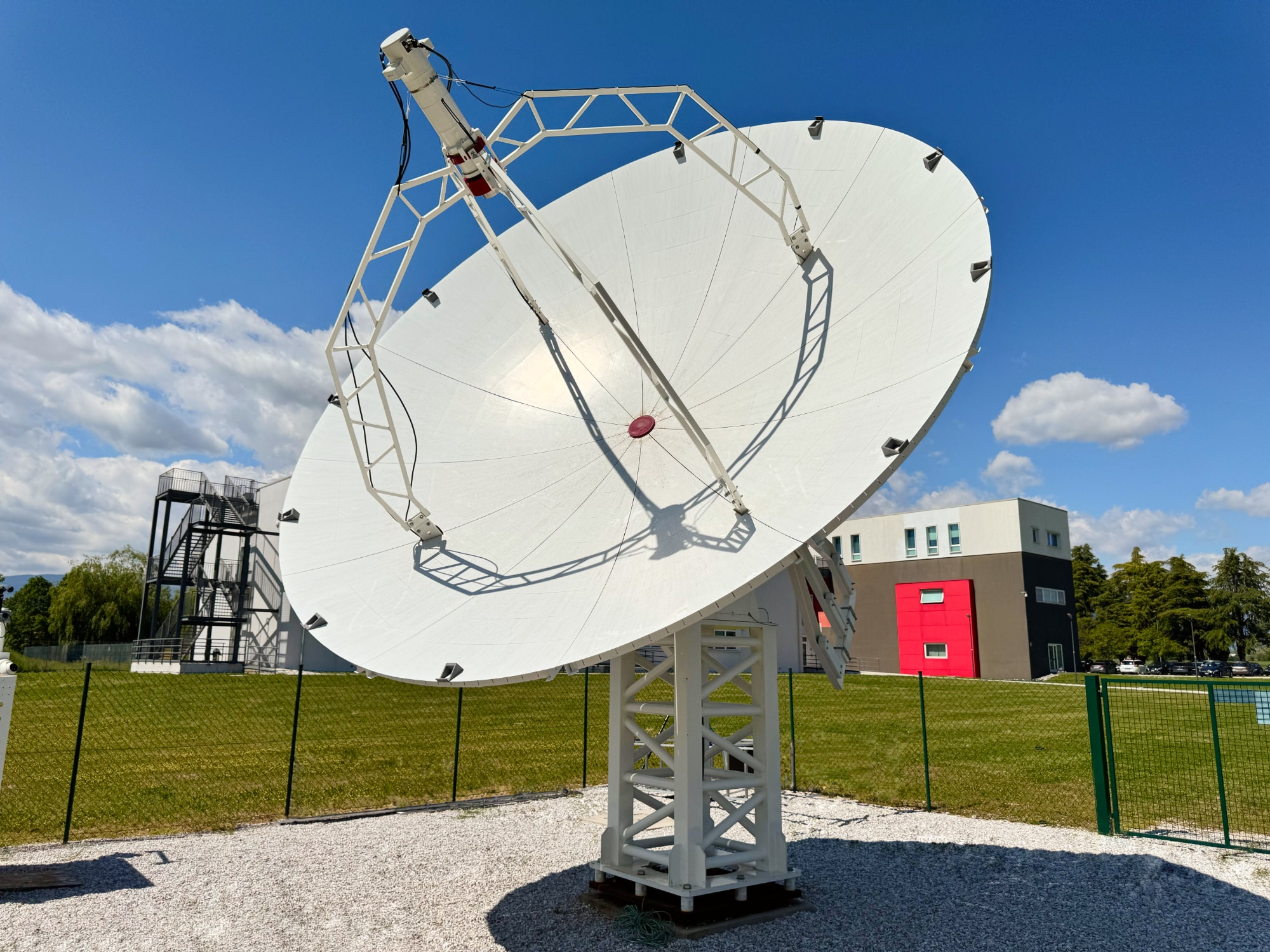
The third is pointing accuracy. A 5-meter dish operating at S-band must track a slowly moving object across the sky with enough precision to maintain signal quality throughout each observation arc. The INTREPID 500-20 achieves 0.05° pointing accuracy, driven by the GS-800II tracking system.
The fourth, and most important, is integration. Antenna, backend, digital processing, orbital modeling, and control software all have to work as a single coherent system. This is precisely what the PL-GSS platform is designed to deliver. The result we obtained is a result of the whole system, not of any single component.
A compact ground station in deep space territory
The INTREPID 500-20 is a professional ground station with a 5-meter dish. It is the flagship of the INTREPID antenna family within our PL-GSS platform, designed to be easy to deploy, easy to integrate, and easy to operate. It is not a research prototype. It runs on the same hardware and software we ship to customers worldwide, tested daily at our PL Space Center.
Ground stations of this class are normally associated with LEO satellite support, cubesat operations, or near-Earth missions. The Artemis II campaign shows that this class of system can operate in a fundamentally different domain. Cislunar space has stricter radiometric requirements, more complex observation geometry, and dynamics that demand a higher level of system coherence than typical Earth orbit scenarios.
Demonstrating that INTREPID 500-20 can work in this regime opens concrete possibilities: independent tracking support for lunar missions, Doppler-based position verification for cislunar spacecraft, orbit determination campaigns, ephemeris validation, and radiometric support for interplanetary probes. These are applications that, until recently, would have been considered out of reach for a compact ground station.
Tracking Artemis II on its way to the Moon: a starting point
The Artemis II tracking campaign is a reference point for what the INTREPID platform can do. Not a demonstration of a concept, but a result obtained with production hardware during one of the most significant space missions of the decade.
Radiometric tracking of cislunar missions has always been the domain of large, dedicated infrastructure, the kind operated by NASA’s Deep Space Network, with antenna diameters measured in tens of meters and decades of institutional investment behind them. This campaign shows that the boundary is moving. A compact, professional ground station, designed to be accessible and easy to integrate, can now operate in that same domain.
At PrimaLuceLab Space Division, this is exactly the direction we are building toward: making cislunar and deep space ground segment capability accessible to research institutions, space agencies, and new space economy companies, at a scale and cost that make it achievable.
Start a technical conversation about your ground segment. Describe your mission, your constraints and where you want to go. We will help you understand whether PL-GSS is the right foundation for your ground segment, now and in the future. Contact the PrimaLuceLab Space Division team.