
On paper, everything often looks under control. The mission plan is clear, the objectives are defined, the spacecraft is in orbit or about to be. But when it comes to the ground segment, reality is usually more fragile than it appears. Many teams discover this during daily operations. Access to space may depend on infrastructure that is not truly theirs. Sometimes it’s a patchwork of systems acquired over time, from different vendors, each one working reasonably well on its own but difficult to operate as a coherent whole. Sometimes it’s a service-based approach, chosen to move fast and avoid complexity, that slowly turns into a constraint. There may be also a quieter frustration, the sense that the mission must adapt to the ground segment, instead of the other way around. For many teams, this is the moment when the problem becomes clear: the ground segment is not failing technically. It is failing strategically.
A different approach: building the ground segment around the mission
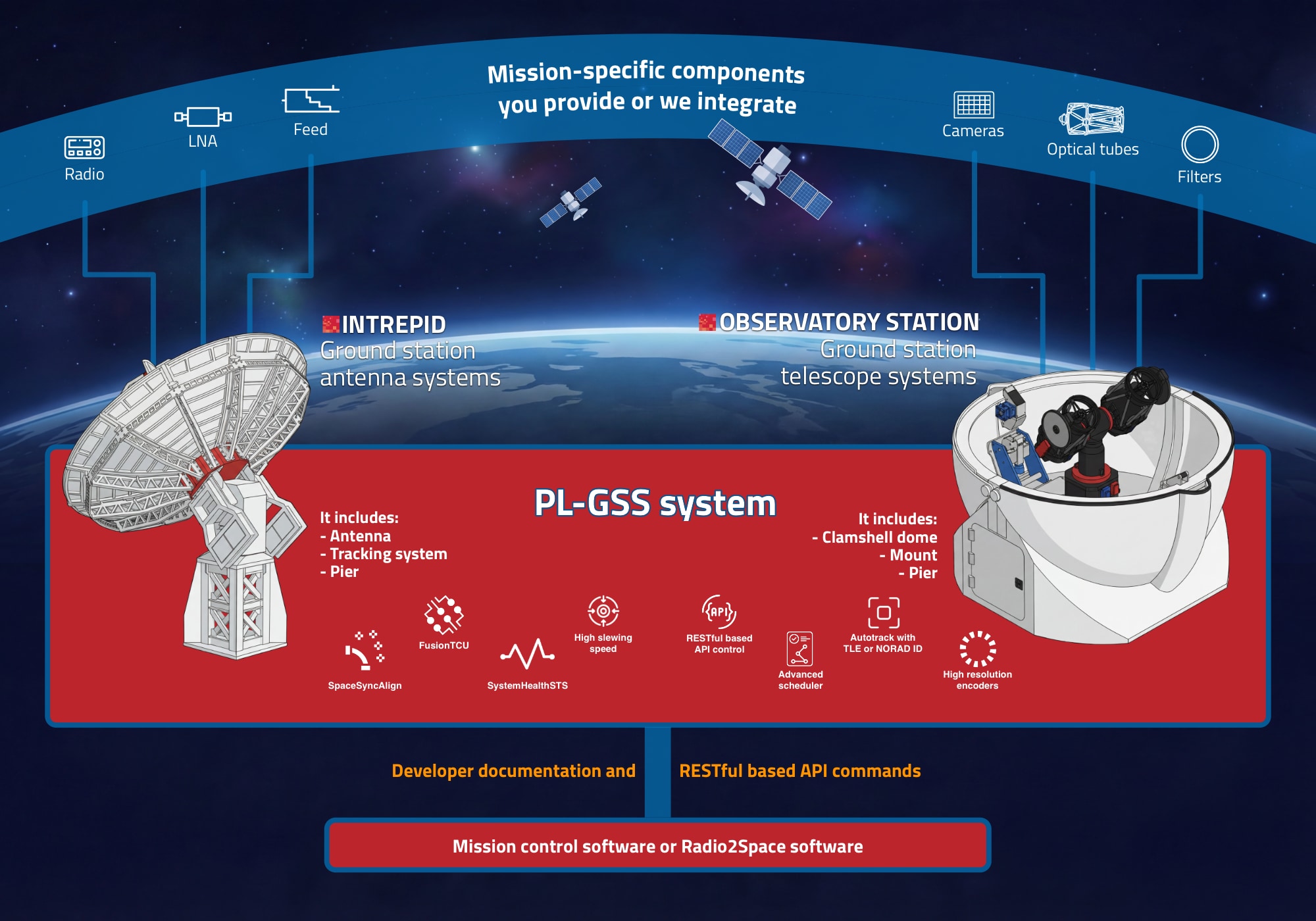
The turning point comes when the question changes. Not “Which ground station should we buy?” or “Which service should we use?”, but “What do we actually need our ground segment to do?”. This is where PrimaLuceLab approach is fundamentally different. Instead of delivering a closed, complex and expensive ground station or a service you must adapt to, we design systems for optical and radio ground stations that act as a solid, mission-ready foundation. Systems that already include the most critical elements of a ground station: mechanics, motion control, tracking, automation, and remote operation. This approach is what we call PL-GSS: the Prima Luce Ground Segment System.
PL-GSS is a system architecture that allows you to build your own ground segment, both for radio and optical applications, by starting from a tested and operational base, rather than designing everything from scratch or delegating control to third parties. You select and integrate the mission-specific components (RF chains, optical tubes, sensors) according to your needs, constraints and confidentiality requirements. The result is a ground segment that adapts to the mission, not the opposite. One that can start compact and focused, then grow, evolve and specialize over time. One that you control directly, technically and operationally. Not a shortcut, but a more effective path toward independent access to space.
What the PL-GSS approach actually includes, and why each element matters
The PL-GSS approach is a carefully designed way to take responsibility for critical parts of a ground segment, while leaving mission-specific choices exactly where they belong: in the hands of those who know the mission best. At the core of PL-GSS are two families of systems:
For radio applications, INTREPID ground station antenna systems provide the mechanical, electromechanical and software infrastructure required to point, track and operate antennas with the precision, speed and reliability demanded by space missions. These systems are designed for continuous operation, remote control and automation, and form the backbone of a radio ground segment that can be directly integrated into existing mission control architectures.
For optical applications, Observatory Stations ground station telescope systems provide the foundational infrastructure of an optical ground station. Domes, mounts, remote control and automation systems are designed to work together as a coherent whole, creating a stable and controllable environment on which optical tubes and imaging sensors can be integrated according to the mission’s observational needs.
What these systems share is a common philosophy. They are not mission-specific by design. They do not lock you into predefined configurations or proprietary workflows. Instead, they handle what is hardest, most time-consuming and most critical to get right in a ground station: motion, tracking, automation, remote operation and system reliability. Everything that depends on the mission itself (RF chains, receivers, cameras, filters, sensors) remains fully under your control.
From architecture to execution: technologies that enable PL-GSS
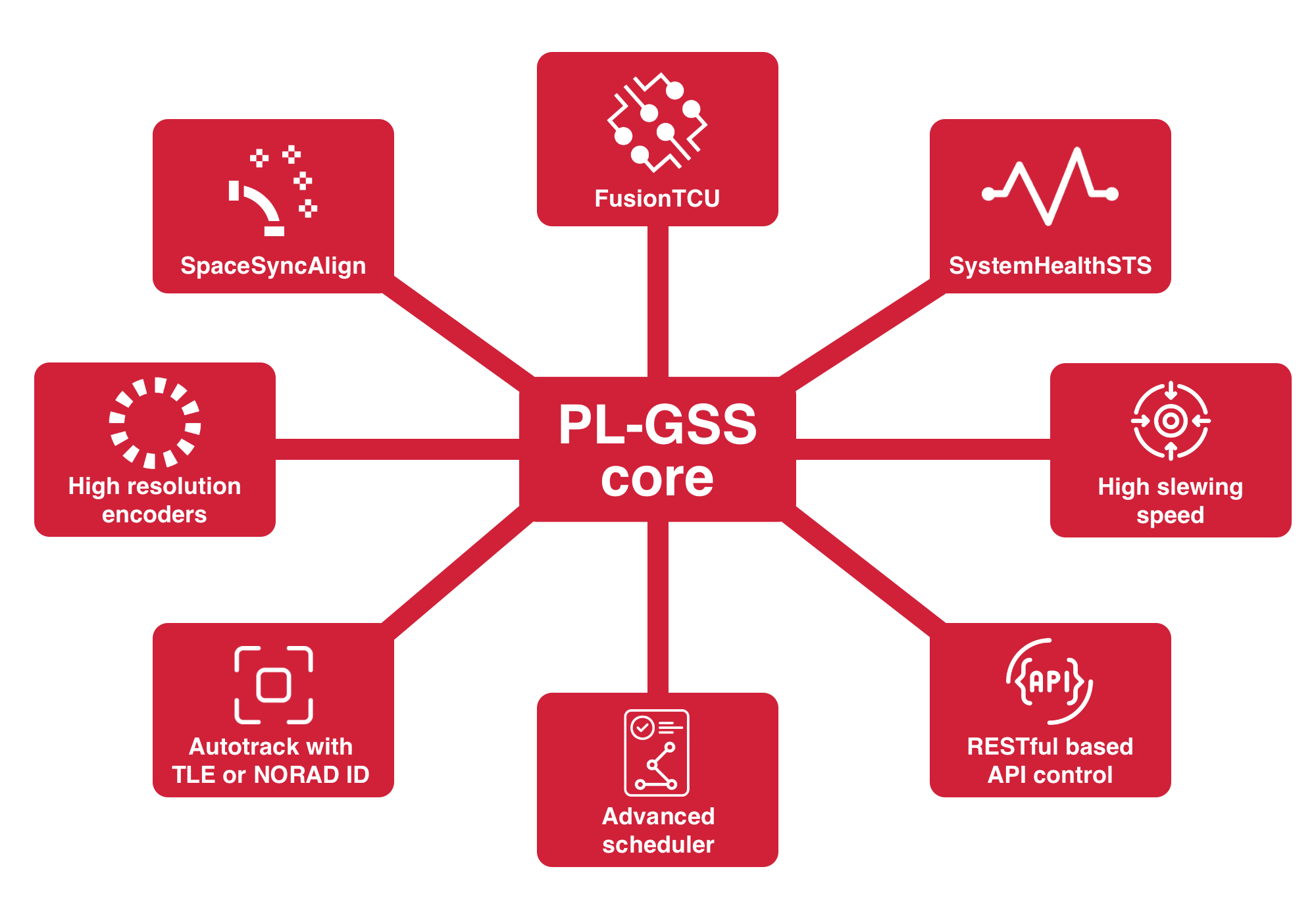
At the heart of PL-GSS systems is an advanced control architecture that enables autonomous operations while preserving safety and transparency. This is achieved through technologies such as FusionTCU, with the N-ACU Next-Generation Antenna Control Unit integrated into the Motor Control System. This architecture allows precise motion control, autonomous tracking and safe operation under a wide range of conditions. Deployment and operational readiness are further simplified through SpaceSyncAlign, a technology designed to support fast and repeatable on-site alignment of ground station systems. Long-term reliability is addressed through SystemHealthSTS, a continuous monitoring framework that supervises the status of critical tracking system components, including motors, encoders, environmental conditions, internal temperatures, fans and power parameters.
Automation is a core principle of PL-GSS. Automatic tracking based on TLE data or NORAD identifiers, combined with an advanced SNAP Command Line-compliant scheduler, enables fully automated point-and-track operations, repeatable workflows and structured reporting. This allows ground segments to operate consistently over time, even as mission requirements evolve. All these technologies are exposed through an open software layer. Developer APIs, based on secure RESTful interfaces with certificate-based authentication, allow PL-GSS systems to be integrated directly into third-party mission control software.
One software philosophy across optical and radio ground stations
Around this hardware foundation sits an open software layer. Control systems are designed to operate standalone when needed, or to integrate directly with your mission control software through developer APIs. This means the ground segment can become part of your existing operational ecosystem, rather than an isolated subsystem that requires special handling.
A key implication of designing both optical and radio ground station systems is that their control architectures are not developed in isolation. The APIs exposed by Observatory Stations and INTREPID systems share common concepts, structures and interaction patterns. For organizations integrating both optical and radio assets into their mission control software, this significantly reduces complexity. Instead of dealing with entirely different control models, teams can work with a consistent approach across the ground segment. The available developer documentation is designed to support this integration, enabling third-party mission control software to interface with optical and radio systems using familiar logic, shared primitives and aligned workflows. The result is not just faster integration, but a ground segment that behaves as a unified system from the software perspective, even when supporting different mission windows and applications.
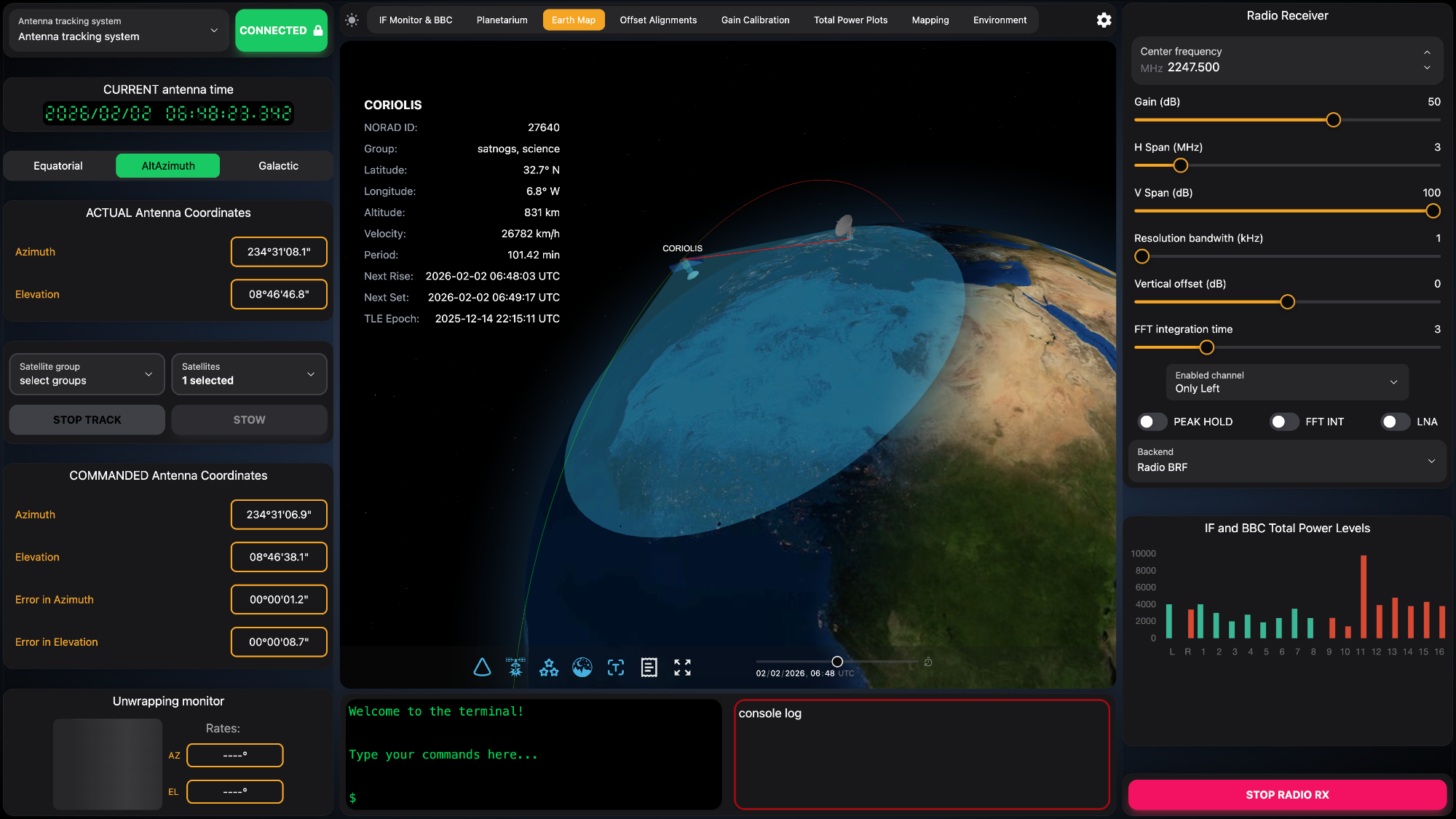
For organizations that do not already operate a proprietary mission control software, we developed Radio2Space, the control software specifically designed for INTREPID ground station antenna systems. Radio2Space enables users to control an INTREPID ground station directly from their computers, combining advanced functionality with ease of use. It provides a comprehensive toolset for ground station management, allowing users to operate, monitor and optimise radio ground station activities without the need to develop custom control software from scratch.
Where PL-GSS is continuously tested, evolved and proven
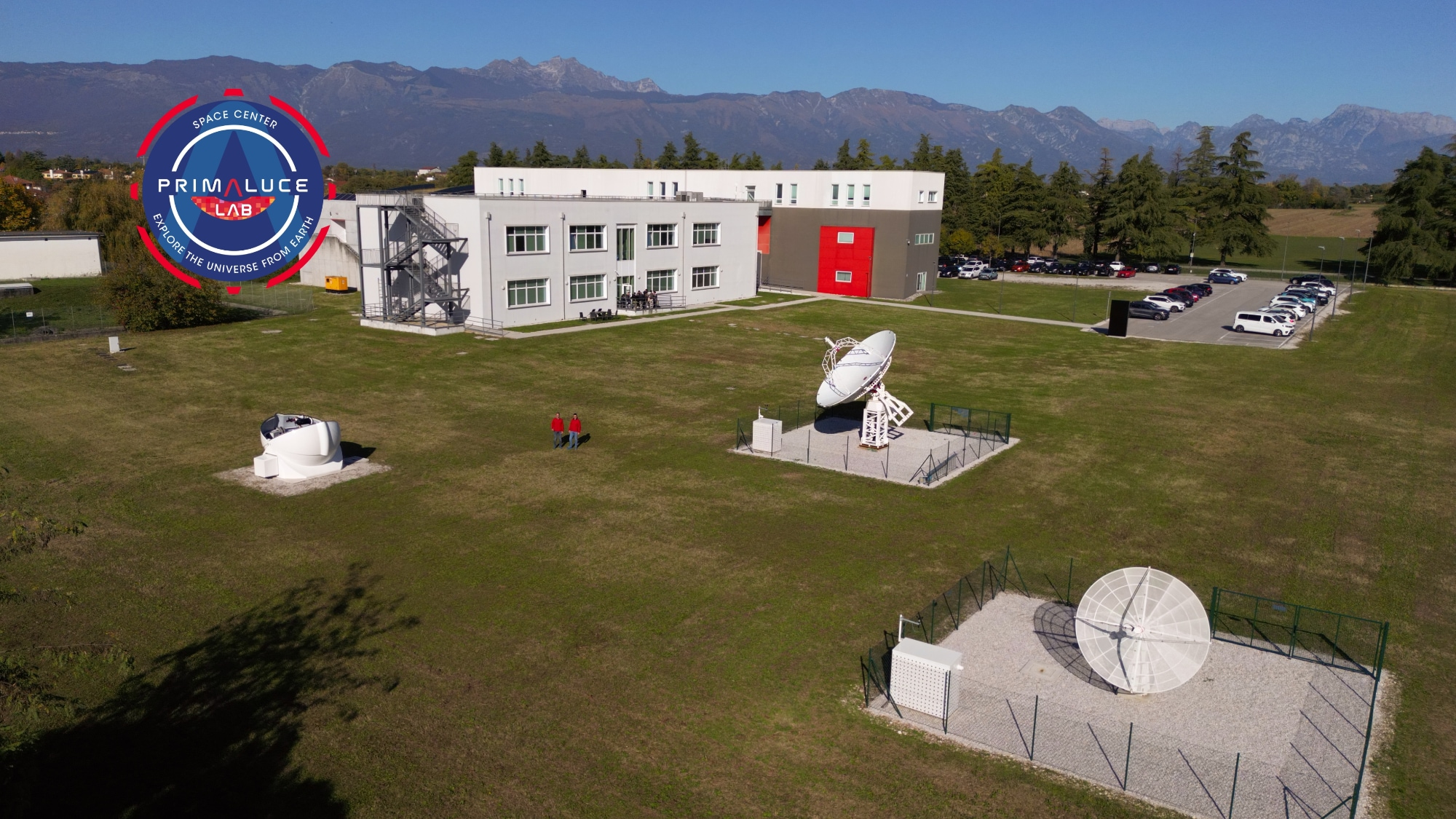
The PL-GSS approach is the result of continuous work carried out inside the PL Space Center, an advanced facility developed by PrimaLuceLab to drive innovation in space-related technologies. The PL Space Center is equipped with both Observatory Station optical ground station and INTREPID radio ground station systems, operating together as a real ground segment. This environment is used every day to test, validate and improve PrimaLuceLab hardware and software solutions under realistic operational conditions. Tracking performance, automation workflows, remote operation, software integration and long-term reliability are not evaluated in isolation, but as part of a complete and functioning system.
This matters because PL-GSS is not designed in abstraction. It is shaped by real usage, real constraints and real operational needs. The same systems offered to customers are the ones used internally to explore new configurations, refine automation strategies and validate integration with mission control software. In this sense, the PL Space Center is not a showroom, but a working ground segment. The existence of the PL Space Center reinforces a simple idea: PL-GSS is not a promise of what could work. It is the result of what is already working, every day, in a controlled but realistic space operations environment.
Why this matters now, and what happens if the decision is postponed
The question of the ground segment tends to stay in the background. The problem is that the context around ground segments is changing faster than most roadmaps anticipate. The number of satellites in orbit continues to grow, while access to shared ground station infrastructure becomes increasingly constrained.
Postponing the decision to take control of the ground segment often means locking in today’s limitations for years to come. Opportunities to build knowledge, refine processes and create long-term value are delayed or lost entirely. Choosing to act means recognizing that building an independent ground segment is not a last-minute procurement, but a strategic capability. One that benefits from being designed, tested and grown alongside the mission.
Questions that naturally come up, and clear answers
When organizations start thinking seriously about building or evolving their own ground segment, a number of practical questions almost always emerge. They are reasonable questions, and addressing them clearly is part of making an informed decision.
“Does this work for our specific mission?”
PL-GSS is designed precisely for situations where missions differ. The systems we provide are mission-agnostic by design, handling the core infrastructure of a ground station while leaving mission-specific elements in your hands. This allows the same architecture to support research missions, operational spacecraft, educational programs or experimental applications, without forcing a predefined use case.
“Do we need to replace everything we already have?”
Not necessarily. PL-GSS is built to integrate with existing mission control software and operational workflows. In many cases, it complements and extends what is already in place, rather than requiring a full replacement. The goal is continuity, not disruption.
“How complex is the integration?”
The most complex parts of a ground station (motion control, tracking, automation and remote operation) are already handled by the systems themselves. Integration focuses on connecting the ground segment to your mission control software through documented APIs. This reduces uncertainty and avoids reinventing infrastructure that has already been tested.
“What if we don’t have our own mission control software?”
PL-GSS is designed to work both with and without a proprietary mission control system. For radio ground stations based on INTREPID, we also developed Radio2Space, a control software that allows users to operate the ground station directly from their computers. This enables teams to become operational without developing custom software from the start, while preserving the option to integrate INTREPID systems into a proprietary mission control software later through APIs.
“What about long-term support and evolution?”
Because PL-GSS is not a fixed configuration but a system architecture, it is designed to evolve. As missions grow or change, the same systems can be expanded, reconfigured or repurposed. Support is not limited to installation, but extends to helping organizations make informed technical decisions as their ground segment develops over time.
“Is this approach suitable for organizations without large internal teams?”
Yes. One of the reasons PL-GSS exists is to reduce the burden of designing and validating a ground station from scratch. By starting from a tested foundation and working directly with the system designers, organizations can build internal competence gradually, without requiring a large, specialized team from day one.
A professional commitment, not a marketing guarantee
Building or evolving a ground segment is a strategic decision. When adopting the PL-GSS approach, you are working with systems that are already operational, continuously used and refined within the PL Space Center, and delivered with clear technical specifications, documented interfaces and defined performance expectations. Beyond the hardware and software themselves, the guarantee is also methodological. The PrimaLuceLab Space Division is able to help teams during the definition and integration, helping to ensure that the systems are used in the way they were designed to be used.
Most importantly, PL-GSS is built to reduce risk, not shift it. By starting from a tested ground station system instead of a blank page, organizations dramatically lower the likelihood of architectural errors, integration dead-ends or operational surprises. The guarantee, in this sense, is embedded in the approach itself: fewer unknowns, and a foundation that has already been proven in practice. This is not a promise that “everything will be easy”. Space operations rarely are. It is a commitment that you are starting from solid ground, with systems, architecture and support designed to make success far more likely.
From dependency to ownership
PL-GSS was created for organizations that choose to operate their own ground segment. Not to replace their mission control software. Not to dictate how your mission should work. But to give them systems that make independent access to space technically realistic, operationally sustainable and economically rational. Owning your ground segment does not mean doing everything alone. It means starting from a foundation that already works, that has been tested in real conditions, and that can grow with you over time. It means turning the ground segment from a recurring concern into a strategic asset.
Start a technical conversation about your ground segment. Describe your mission, your constraints and where you want to go. We will help you understand whether PL-GSS is the right foundation for your ground segment, now and in the future. Contact the PrimaLuceLab Space Division team.